

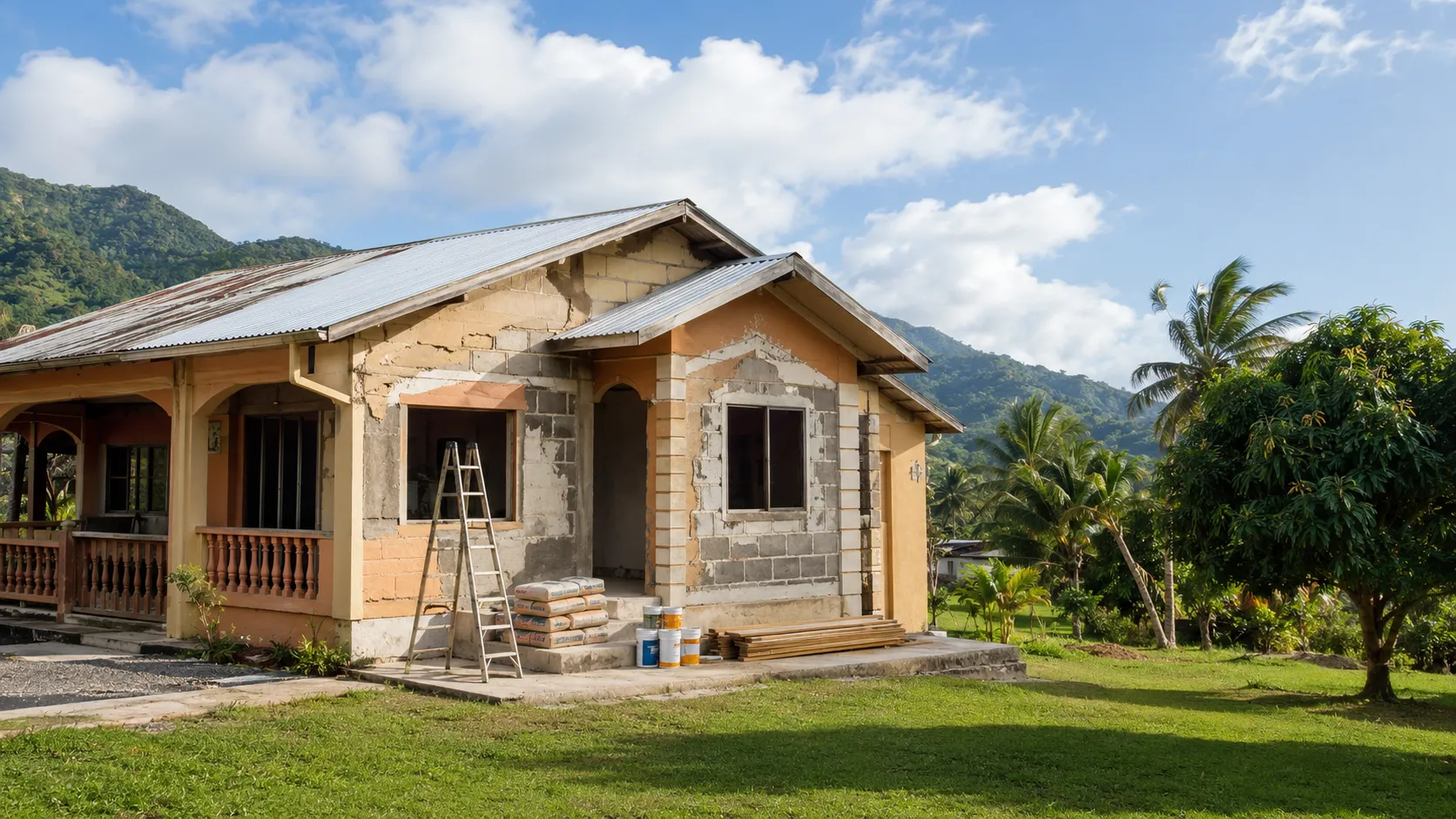
Tunapuna and the wider East-West Corridor hold some of the oldest housing stock in Trinidad — which is exactly why entry-level fixer-uppers here can still be found from roughly TTD $600,000 to $800,000 while move-in-ready homes in the same streets ask two to three times that. This guide is built for buyers looking at distressed or “as-is” houses in Tunapuna, St Joseph, Curepe, St Augustine and Barataria: what they cost, what to inspect, how to finance one the bank calls “uninhabitable”, and which grants and stamp-duty reliefs cut the bill. For the Trinidad-wide picture, see our full fixer-upper houses buyer’s guide.
Table of Contents
Why Tunapuna and the East-West Corridor have so many fixer-uppers
The corridor was built out mainly between the 1960s and 1980s as Port-of-Spain’s population pushed east onto former cocoa and sugar estates. That housing is now 40–60 years old, so Tunapuna, St Joseph and St Augustine carry far more aging, repairable stock than newer Central developments like Chaguanas or Couva.
Residential lots along the corridor typically run 4,000 to 6,000 sq ft. Construction is usually load-bearing concrete blockwork on a flat slab, or older raised stilt houses on concrete columns built for ventilation and flood protection — with a fair number of timber and hybrid concrete-timber homes mixed in. Because of their age, these properties are prone to the same set of defects: rusted corrugated galvanise roof sheets, deteriorated wiring, corroded galvanised plumbing lines, subterranean and drywood termite damage, and foundation settlement cracks. None of those rule a house out — but each one belongs in your offer price.
What fixer-upper houses cost in Tunapuna and the corridor right now
Entry-level distressed 3-bedroom homes along the corridor sit around TTD $600,000–$800,000. Larger lots, commercial-residential frontage on the Eastern Main Road, or bigger “as-is” homes on generous grounds push well past TTD $3M. Asking prices track land value and frontage more than building condition.
| Area | Property type | Size (lot / building, sq ft) | Asking price (TTD) |
|---|---|---|---|
| Tunapuna (Kewley St) | 3-bed, 1-bath stilt house, residential fixer-upper | 4,695 / 2,000 | $1,850,000 |
| Tunapuna (Main Rd) | 2-storey commercial/residential, high traffic | 5,200 (lot) | $5,000,000 |
| St Joseph (Elizabeth St) | 3-bed, “as-is” home on spacious grounds | 13,000 (property) | $3,925,000 |
| Barataria (Tenth Ave) | 6-bed residential/commercial fixer-upper near highway | 8,655 / 2,680 | $4,750,000 |
| Corridor entry-level | Distressed 3-bed, deferred maintenance | ~5,000 / ~1,200 | $600,000–$800,000 |
Indicative of active corridor listings, 2026. Asking prices, not sale prices — verify current availability before you offer.
Browse current inventory on our houses for sale in Trinidad hub.
How to spot structural problems before you buy
Trinidad has no state-licensed home-inspection industry, so due diligence on an “as-is” corridor house falls to an independent RICS-certified valuer or structural engineer plus licensed tradesmen — hired before you sign an Agreement for Sale or pay a 10% deposit.
On older corridor homes, focus on three checks: a structural look for slab cracking and mortar-joint separation that signals foundation settlement; a wood and pest “tap test” on beams and rafters, where hollow, papery feedback means subterranean or drywood termite damage; and drainage and grading, confirming rainwater runs away from the foundation through the box drains rather than pooling against it. A full residential valuation runs about 0.25% of value plus 12.5% VAT (minimum roughly TTD $2,200–$2,500 under $1M; about TTD $4,000–$5,000 on a $1.5M home), and a cadastral boundary survey, often worth it on older Common Law titles, runs TTD $3,000–$10,000. Our pillar guide explains how to tell a cosmetic fix from a structural problem in detail.
How much it costs to renovate a corridor fixer-upper (indicative 2026)
Budget by scope: a cosmetic refresh on a small corridor house runs roughly TTD $50,000–$150,000; a mid-range renovation TTD $150,000–$400,000; and a full structural gut about TTD $100–$150 per sq ft (so ~TTD $120,000–$180,000 on a 1,200 sq ft home). Add a 15% contingency on top.
| Renovation element | Indicative rate (TTD/sq ft) | Typical job (TTD) |
|---|---|---|
| Electrical rewiring | $10–$25 | $15,000–$35,000 (+$10k–$15k for a 200-amp panel) |
| Plumbing repiping (galvanise → PVC/PEX) | $15–$30 | $15,000–$40,000 |
| Roof replacement (galvanise) | — | $60,000–$120,000 |
| Kitchen remodel | $150–$350 | $25,000–$75,000 |
| Bathroom remodel | $120–$280 | $15,000–$45,000 |
| Tiling & flooring | $12–$25 | $15,000–$45,000 |
| Structural & masonry | $80–$160 | $20,000–$60,000 |
| Painting & partitioning | $8–$18 | $10,000–$30,000 |
Indicative ranges for 2026, for budgeting only. Confirm against a written contractor or quantity-surveyor estimate for your specific property.
Labour day-rates run roughly: general labourer TTD $150–$250; mason TTD $300–$500; finish carpenter TTD $350–$550; licensed electrician or plumber TTD $450–$700. A general contractor typically adds a 10–15% management fee on the total build cost.
2026 material prices have jumped. Effective 9 February 2026, Trinidad Cement Limited (TCL) raised cement-sack prices by 15%, taking a bag from about TTD $68 to roughly TTD $77 VAT-inclusive — driven by a retroactive 77% increase in National Gas Company industrial tariffs. Imported Rock Hard cement has held at about TTD $62 VAT-inclusive, and ABEL Building Solutions has warned of clay-block increases too. That volatility is why a 15% contingency is now standard on any corridor renovation. For the full national cost breakdown see the renovation cost section of our buyer’s guide.
Financing a fixer-upper the banks call “uninhabitable”
A standard residential mortgage will not fund a home a valuer deems uninhabitable — one without a working kitchen, indoor bathroom, watertight roof, safe wiring or running water. The local workaround is short-term bridging finance secured against the land plus the projected completed value, released in tranches and converted to a normal mortgage once the corridor receives its Completion Certificate.
Bridging facilities pay out in stages against a builder’s estimate, approved plans and a Quantity Surveyor’s report, with the bank inspecting at milestones before each release; you usually pay interest-only during construction. Trinidad & Tobago lenders structure this in a few ways:
| Lender / product | Indicative terms | Notes |
|---|---|---|
| Republic Bank — Build Easy / bridging | Installment capped at 40% of gross monthly basic salary (45% with other debt) | Needs builder’s estimate, approved plans and QS report; medium-term facility can also cover closing costs |
| Scotiabank — Home Builder Loan | Interest-only during construction; up to 100% financing options | Converts to a standard amortizing mortgage on final structural sign-off |
| First Citizens Bank — unsecured home improvement | Up to TTD $350,000; up to 7 years; APR up to ~14.25% | No property valuation or structural approval required — good for cosmetic/mid-range work |
| TTMB — standard & subsidized | Standard 6%; subsidized 2% (income ≤ $14,000/mo) or 5% (≤ $30,000/mo) | Renovation/extension allowed under subsidized programmes with approved Town & Country plans |
Indicative 2026 terms — confirm current rates and limits directly with each lender.
Grants and stamp-duty relief that cut your costs
Two Ministry of Housing programmes help fund repairs: the Home Improvement Grant (up to TTD $15,000, non-repayable) and the Home Improvement Subsidy (up to TTD $20,000 as a matching contribution). First-time buyers also pay zero stamp duty on a house-and-land purchase up to TTD $2,000,000.
| Programme | Max amount | Income cap | Min age |
|---|---|---|---|
| Home Improvement Grant (HIG) | TTD $15,000 (no repayment) | $5,000/month household | 21 |
| Home Improvement Subsidy (HIS) | TTD $20,000 (matching) | $120,000/year household | 18 |
Both are run by the Ministry of Housing and Urban Development, require proof of legal land tenure, and pay out in two instalments as approved work is completed. Full eligibility and the step-by-step process are in our guide to the Home Improvement Grant and Subsidy. On the purchase itself, a qualifying first-time buyer saves up to TTD $49,500 in stamp duty on a $1.5M home — run your own numbers with our Trinidad stamp duty calculator.
Permits and the Tunapuna-Piarco Regional Corporation process
Internal cosmetic work needs no permit. Any structural change, extension or footprint modification needs Town & Country Planning approval through the DevelopTT portal, plus a Tunapuna-Piarco Regional Corporation (TPRC) building permit — about TTD $500 — with a Completion Certificate (search fee TTD $100–$150) issued after final inspection.
For most of the corridor, the TPRC is your local building inspectorate: it reviews plans, inspects during construction and enforces code. That Completion Certificate matters beyond compliance — it’s what lets you update home insurance, adjust the property-tax record, and convert a short-term bridging loan into a standard mortgage. Older corridor properties are predominantly Common Law title, so budget for a manual title search (attorney fees roughly TTD $500–$1,500) tracing the deed back 20–30 years, and make sure the vendor delivers a WASA Clearance Certificate before closing.
Frequently asked questions
Can I get a standard mortgage for an uninhabitable fixer-upper in Trinidad?
No. Standard residential mortgages can’t be secured against a property a registered valuer deems uninhabitable — one lacking a working bathroom, kitchen or watertight roof. You use a short-term bridging loan to fund the purchase and renovation, then convert it to a standard mortgage once the Tunapuna-Piarco Regional Corporation issues a Completion Certificate.
What is the maximum stamp-duty exemption for a first-time buyer?
Qualifying first-time buyers are fully exempt from stamp duty on a combined house-and-land purchase valued up to TTD $2,000,000. Repeat buyers are only exempt up to TTD $850,000. All joint purchasers must be first-time buyers to get the full exemption.
How much does the Home Improvement Subsidy provide and who qualifies?
The HIS provides a matching contribution of up to TTD $20,000 for approved repairs. Applicants must be citizens or residents aged 18+, with annual household income of TTD $120,000 or less, valid proof of land tenure, and no prior benefit from the Ministry’s housing programmes.
How have 2026 material costs affected renovation budgets?
In February 2026 Trinidad Cement Limited raised cement-sack prices 15%, to about TTD $77 VAT-inclusive, after a retroactive 77% national gas tariff hike. With clay-block increases also flagged, a 15% budget contingency is now standard on any corridor renovation.
Do minor cosmetic repairs need planning permission?
No. Internal cosmetic work — painting, flooring, tiling, replacing cabinetry or bathroom fixtures — needs no Town & Country or municipal approval. Only structural additions or external expansions require submission through the DevelopTT portal.
Is a WASA Clearance Certificate required to buy an “as-is” property?
Yes. Conveyancing attorneys require a WASA Clearance Certificate confirming all water and sewerage rates are paid before title transfers. Any outstanding arrears are the vendor’s legal responsibility and must be cleared before closing.
Ready to start your search? Browse houses for sale in Trinidad or read the full fixer-upper buyer’s guide.



Join The Discussion