
Quick Answer
A freehold property gives you absolute, perpetual ownership of land; a leasehold townhouse gives you the right to occupy a unit for a fixed lease term — typically 199 or 999 years on new developments.
In Trinidad, freehold land ranges from TTD $420,000 to $3.5M+ depending on location, while leasehold townhouses in gated communities range from TTD $1.15M to $6.95M. For most buyers, the practical difference is not the lease term — modern 199-year and 999-year leaseholds are effectively equivalent to freehold for financing and resale purposes. The real decision comes down to lifestyle, security needs, and investment horizon: land suits patient investors and self-builders; townhouses suit buyers who want immediate security and a turnkey home.
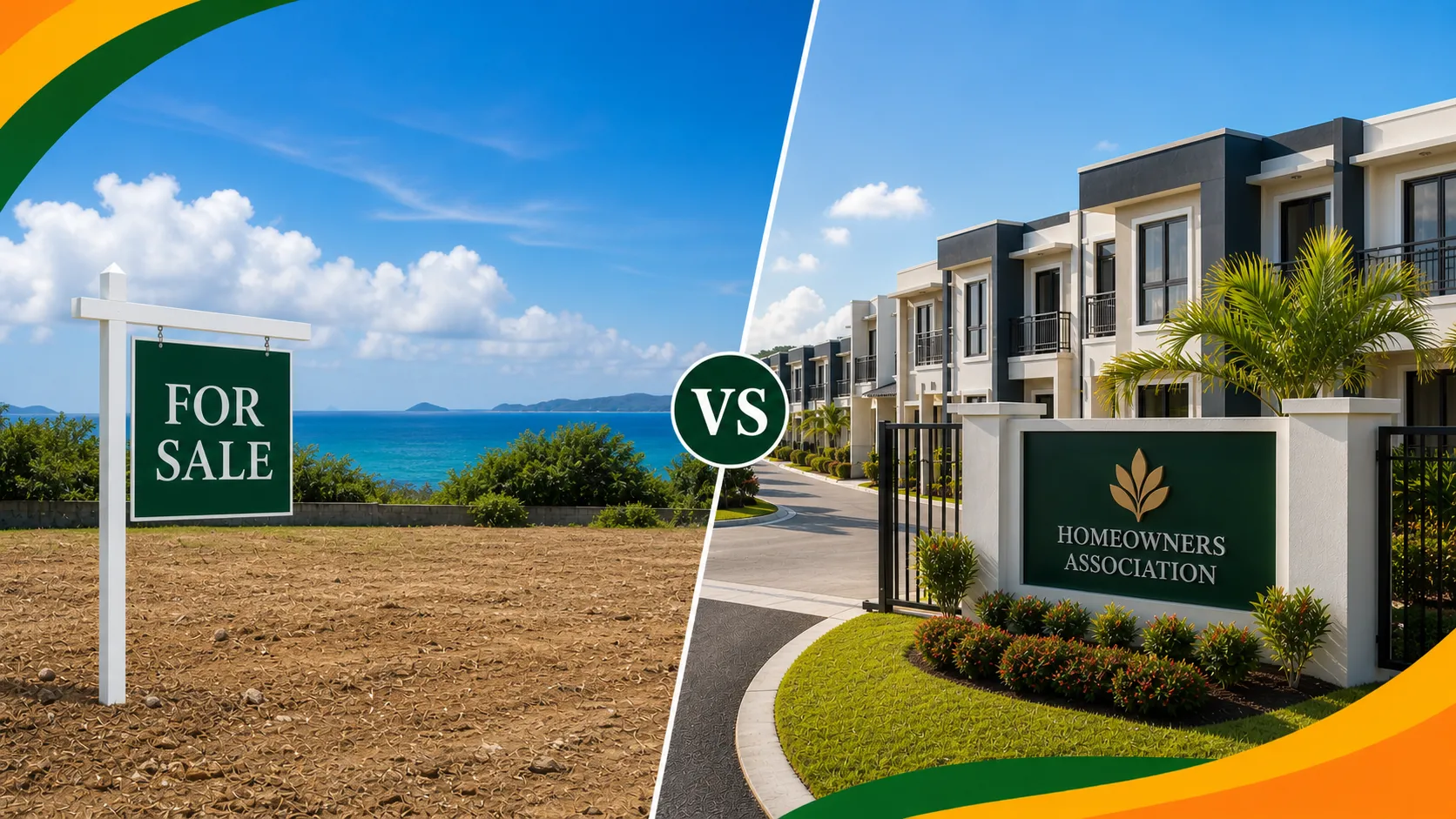
The choice between buying freehold residential land and purchasing a leasehold townhouse in a gated community is one of the most consequential property decisions a buyer in Trinidad and Tobago can make. It affects your monthly cash flow, how easily you can sell, how banks assess your collateral, and whether the asset you leave to your children is legally straightforward to inherit.
This guide cuts through the legal terminology and gives you the numbers, the rules, and the buyer profiles that determine which option is right for your situation.
Table of Contents
What Is the Difference Between Freehold and Leasehold Property in Trinidad?
A freehold estate is an absolute interest in land. You own it indefinitely — subject only to TCPD zoning rules, land taxes enforced by the Valuation Division, and standard statutory regulations. There is no expiry date, no landlord, and no requirement to seek permission before selling.
A leasehold interest gives you the exclusive right to occupy a property for a defined number of years. The underlying land remains owned by a freeholder — which may be the State, a private landowner, or a Management Company. Most townhouses in Trinidad’s gated communities are sold as leaseholds: you buy the unit, and simultaneously receive a share in the Management Company that holds the freehold title to the communal land.
Property transactions in T&T fall under one of two registration systems:
- Old Law (Conveyancing and Law of Property Act): Title is transferred by a Deed of Conveyance (freehold) or Deed of Lease / Deed of Assignment (leasehold). Each sale requires a new deed and a manual title search tracing ownership back 20–30 years.
- RPO / Torrens System (Real Property Act): A state-guaranteed Certificate of Title is issued. Transfers are recorded by endorsement — faster, cheaper, and more fraud-resistant.
Knowing which system applies to your property is the first step your conveyancing attorney must confirm before any sale proceeds.
What Is the “Consent to Sell” Requirement on Leasehold Properties?
Because the freeholder retains a reversionary interest in leasehold land, the lease document almost always requires the leaseholder to obtain the freeholder’s written permission before selling or transferring the property.
On State Lands: Consent must come from the Commissioner of State Lands. This requires up-to-date lease rent receipts, WASA clearance certificates, BIR clearances, and proof all covenants have been honoured. Processing can take several months — and up to a year if the file has historical irregularities.
On private gated community townhouses: Consent is handled by the Management Company. It is faster, but requires proof that all HOA fees are fully paid and that no unauthorised exterior modifications have been made. Your attorney will charge separately for the consent letter and the Share Certificate transfer.
This bureaucratic layer adds cost and time to every leasehold resale. Freehold land sales are bilateral — seller, buyer, attorneys. Leasehold townhouse sales are trilateral — and dependent on a third party (the Management Company) being well-administered and responsive.
How Much Does Freehold Land Cost in Trinidad?
Freehold land prices are highly localised. Proximity to commercial hubs, highway access, and topography all drive significant variation. Based on 2024–2025 market data:
| Region | Avg. Lot Size (sq ft) | Price Range (TTD) | Price per sq ft (TTD) |
|---|---|---|---|
| Port of Spain environs | 5,000 – 10,000 | $1.5M – $3.5M+ | $300 – $500+ |
| Arima / East Trinidad | 5,000 – 11,000 | $575,000 – $900,000 | $75 – $115 |
| Chaguanas / Central | 5,000 – 6,500 | $610,000 – $750,000 | $90 – $125 |
| San Fernando / South | 4,000 – 10,500 | $420,000 – $600,000 | $45 – $105 |
Remember: the land price is only the starting point. A self-builder must also budget for TCPD approvals, site preparation, construction materials, and labour. Most construction projects in T&T run over time and over budget.
Browse current land for sale in Trinidad to see active listings across all regions.
How Much Do Leasehold Townhouses Cost in Trinidad?
Townhouses carry a significant premium over raw land — the purchase price includes a completed structure, communal infrastructure, and integrated security. The market is segmented into distinct tiers:
| Community / Region | Target Buyer | Price Range (TTD) |
|---|---|---|
| Trincity / Couva / Arima | First-time buyers, young professionals | $1.2M – $1.6M |
| Valsayn / Palmiste | Established professionals, growing families | $1.8M – $2.5M |
| La Romaine / South | Southern / energy sector professionals | $1.15M – $1.5M |
| Westmoorings / North-West | High-net-worth individuals, expatriates | $5.8M – $6.95M |
According to Terra Caribbean, the highest volume of transactions occurs in the TTD $1.2M–$2.0M bracket — exactly where the T&T middle class qualifies for mortgage financing at major banks.
Does leasehold status reduce the price? For new 199-year and 999-year leases, the answer is effectively no. The market applies virtually zero discount to these long leaseholds compared to freehold equivalents, because the lease duration vastly exceeds the building’s structural lifespan and the buyer’s planning horizon. Price is driven by location, condition, and HOA quality — not the technical label of “leasehold.”
A steep discount only emerges when a lease has fewer than 50 years remaining. Commercial banks will not finance these properties, which eliminates most buyers and forces the seller to negotiate with cash purchasers who know their leverage.
What Are HOA Maintenance Fees and What Do They Actually Cover?
Every leasehold townhouse in a gated community comes with a mandatory monthly maintenance fee paid to the Homeowners Association (HOA) or Management Company. There is no opting out.
In entry-to-mid-tier developments like Millennium Park in Trincity, fees typically run TTD $1,500–$3,000 per month. In premium developments, fees are substantially higher. These funds cover:
- 24/7 security — manned guardhouses, CCTV, motorised access gates. This is consistently the largest single line item in any HOA budget and the primary reason buyers pay the premium.
- Blanket insurance — covers the building exterior and all common areas against fire, earthquake, and liability. You still need separate contents insurance for your belongings.
- Infrastructure maintenance — communal gardens, internal roads, pool cleaning, exterior painting, and critically in T&T — communal water reserve tanks and pumps to manage municipal supply interruptions.
- Administration — accounting, legal retainers, and management company staff.
What happens if you stop paying? Unlike some US jurisdictions where an HOA can foreclose within months, T&T law requires the Management Company to file a civil claim in the High Court, obtain a judgment, and register it against your title as a formal lien. That lien — and any lis pendens registered during litigation — effectively freezes the property: no bank will finance a buyer, and no rational buyer will proceed without the debt being cleared at closing. The legal process is slower, but the eventual outcome for a chronically delinquent owner is the same: compelled sale by court order.
How Do Banks in Trinidad Finance Each Property Type?
Republic Bank, First Citizens Bank (FCB), and Scotiabank T&T all offer up to 90% financing on residential property, with amortisation periods up to 30 years. Debt-service rules are standard: your mortgage instalment cannot exceed 40% of your gross monthly basic salary, and total debt servicing across all loans cannot exceed 45%.
The documents differ significantly between the two asset types:
| Document Required | Freehold Land | Leasehold Townhouse |
|---|---|---|
| Purchase Agreement | ✓ | ✓ |
| Title Deed / RPO Certificate | ✓ | ✓ |
| WASA Clearance Certificate | ✓ | ✓ |
| Valuation Report (bank-approved appraiser) | ✓ | ✓ |
| TCPD Approval (residential zoning) | ✓ | — |
| Management Company Articles of Association | — | ✓ |
| Share Certificate (Management Company) | — | ✓ |
| Blanket Insurance Certificate (full structure) | — | ✓ |
| HOA Fee Clearance Letter | — | ✓ |
| Lease Rent Receipts (ground rent) | — | ✓ |
The minimum remaining lease rule is critical. T&T commercial banks require the unexpired lease term to exceed the mortgage duration by an additional 10 to 35 years. If you are applying for a 30-year mortgage, the property must typically have at least 40–65 years remaining on its lease. For new 199-year or 999-year leaseholds, this is never an issue. For older properties, it can completely block financing.
The Trinidad and Tobago Mortgage Bank (TTMB) — formed from the merger of TTMF and the Home Mortgage Bank — offers subsidised rates of 2% and 5% to eligible first-time homeowners who meet specific income thresholds. Under the Government Aided Self-Help Housing Programme, citizens without land can access TTMB financing to build on state-developed lots sold at 30% of market value. If you qualify, this dramatically changes the long-term cost of land ownership versus buying a townhouse at market rates.
See the legal process of buying property in Trinidad for a detailed breakdown of conveyancing steps, attorney fees, and what to expect from due diligence.
Which Holds Its Value Better — Freehold Land or a Leasehold Townhouse?
Freehold land offers superior long-term capital appreciation. Raw land does not depreciate, requires near-zero maintenance, and grows in value passively through urban expansion and infrastructure investment. Investors who bought land in Central Trinidad — Chaguanas, Freeport, Cunupia — five years ago have seen substantial equity growth driven by highway expansion and commercial development. Land banking remains one of the most effective inflation hedges available to T&T investors.
Leasehold townhouses follow a more complex trajectory. The physical structure depreciates over time, and HOA fees represent a constant holding cost. However, the security premium has rewritten the appreciation equation. Well-managed gated communities in T&T have posted resilient price growth that significantly outperforms standalone freehold houses in open, less secure neighbourhoods. According to industry data from Terra Caribbean and AREA, the value of a townhouse in 2026 is derived less from the land beneath it and more from the curated security ecosystem the HOA maintains.
The average exposure period to sell is 3–6 months for both asset classes when priced correctly. Freehold land sales are simpler. Townhouse resales carry more administrative friction — but market liquidity in the TTD $1.2M–$2.0M bracket remains exceptionally strong.
Who Should Buy Freehold Land vs a Leasehold Townhouse?
The optimal choice cannot be reduced to a single financial metric. It requires honest alignment with your risk tolerance, lifestyle demands, and investment horizon.
Buy freehold land if you are:
- A self-builder with the liquidity and project management appetite to construct a custom home, navigate TCPD approvals, and manage contractors.
- A long-term investor or land banker seeking a passive, low-cost-to-hold asset that appreciates quietly over decades without monthly HOA obligations.
- A generational wealth planner prioritising a clean, perpetual, unencumbered asset that passes to heirs without corporate share transfers or lease complexity.
Buy a leasehold townhouse if you are:
- A first-time buyer or young professional who wants immediate entry into the market without the stress and cost overruns of self-construction. The TTD $1.2M–$1.6M bracket in Trincity, Couva, or La Romaine aligns with standard mortgage pre-qualification.
- A security-conscious family for whom 24/7 professional security is non-negotiable. An HOA amortises the cost of corporate-grade security across dozens of units — making it economically viable for the middle class.
- An investor or corporate landlord purchasing in Westmoorings or Trincity for expatriate or executive tenants who expect pools, manicured grounds, and controlled access.
- A downsizer moving out of a large, high-maintenance freehold property and outsourcing landscaping, security, and exterior upkeep to a Management Company.
Neither asset class is universally superior. A well-chosen freehold plot in a rapidly developing node delivers unmatched long-term equity. A leasehold townhouse in a well-managed gated community delivers immediate security, rental yield, and transactional liquidity. The right answer depends entirely on whether you are building generational wealth slowly or need a secure home — and mortgage — today.



Join The Discussion